
Reading Time: est. 18 minutes
On this page
You snapped at your partner over something small. You’ve been catastrophizing about a project that’s going fine. If you’re a Type 7, you might have caught yourself making lists of everything that’s wrong lately— picking at things you’d usually let slide.
That’s your stress arrow. It runs a pattern, and once you can see the pattern, you can work with it.
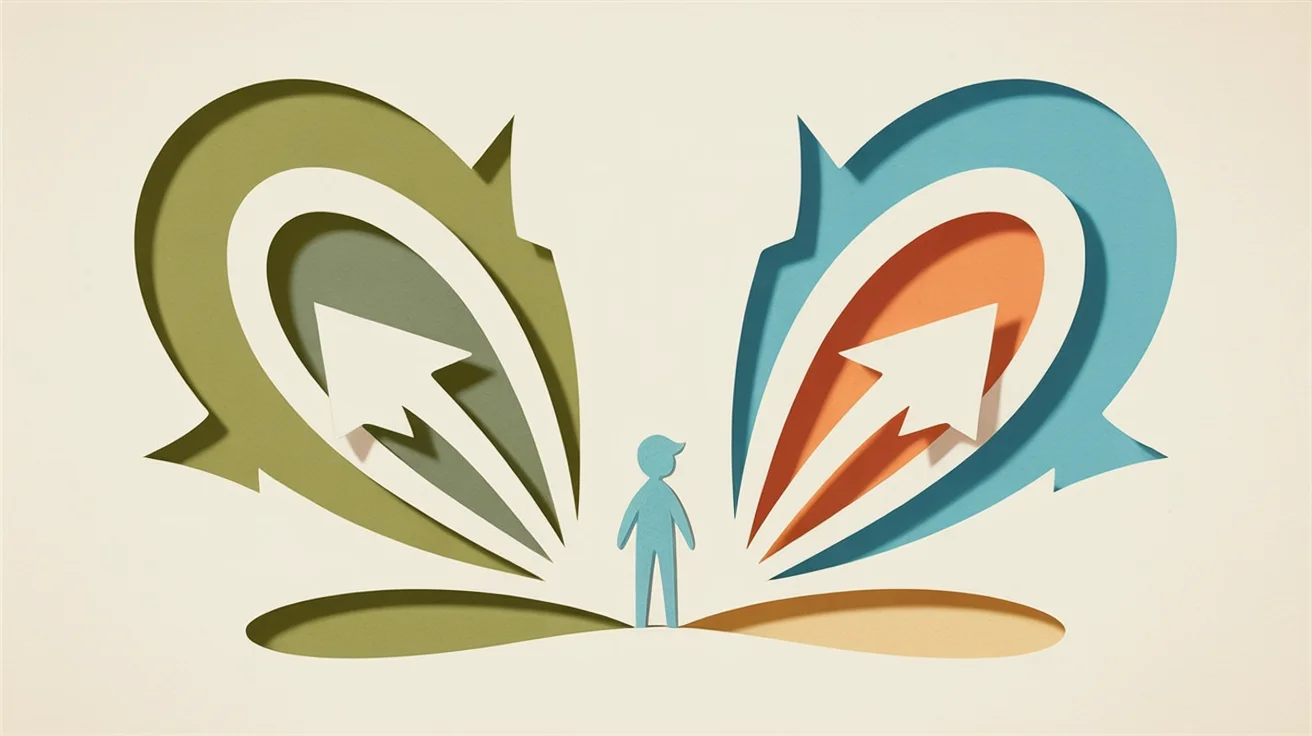
Enneagram stress and growth lines are the arrows connecting each personality type to two others on the Enneagram symbol— one showing how you behave under sustained pressure (the stress or disintegration arrow), one showing your direction of development (the growth or integration arrow). Under chronic stress, you take on the less-healthy behaviors of your stress type. When you’re thriving and growing, you naturally access the positive qualities of your growth type. Every one of the nine types has a specific stress point and growth point, and both follow predictable sequences.
What the Stress and Growth Arrows Are
Every Enneagram type is connected by lines to two others on the symbol. One line shows where your personality goes under chronic stress. The other shows the direction of your growth.
The Enneagram Institute, founded by Don Richard Riso and Russ Hudson, calls these the Direction of Disintegration (the stress arrow) and the Direction of Integration (the growth arrow). You don’t become a different type when you move along these lines. You access behaviors of that type.
The sequences follow two patterns—
- Stress (disintegration): 1→4→2→8→5→7→1 (hexagram) and 9→6→3→9 (triangle)
- Growth (integration): 1→7→5→8→2→4→1 and 9→3→6→9 (triangle reversed)
One way to remember the hexagram sequence: the numbers 1-4-2-8-5-7 are the first six repeating digits of 1÷7 = 0.142857. It’s a mathematical pattern built into the symbol itself.
A quick example: a Type 1 under chronic stress starts acting like an unhealthy Type 4— moody, withdrawn, self-critical in a way that feels unfamiliar. In growth, that same Type 1 starts reaching healthy Seven qualities and gets lighter, more spontaneous, more willing to enjoy things.
Don Richard Riso and Russ Hudson wrote about these patterns at length in The Wisdom of the Enneagram— still the standard reference on the system. As the Enneagram Institute notes, the arrows are one of the most underused parts of the system.
“To obtain a complete picture of yourself, you must take into consideration the basic type and wing as well as the two types in the Directions of Integration and Disintegration.”— Enneagram Institute
Here’s the full picture for all nine types.
The Full Type-by-Type Map
The table below shows exactly where each type goes under stress and in growth, plus what that shift actually looks like in behavior.
| Type | Stress Point | Stress Behaviors | Growth Point | Growth Behaviors |
|---|---|---|---|---|
| Type 1 | Type 4 | Moody, self-critical, withdrawn | Type 7 | Spontaneous, joyful, flexible |
| Type 2 | Type 8 | Controlling, aggressive, domineering | Type 4 | Self-aware, emotionally honest |
| Type 3 | Type 9 | Disengaged, passive, going through the motions | Type 6 | Collaborative, loyal, committed to others |
| Type 4 | Type 2 | Dependent, validation-seeking, reactive | Type 1 | Disciplined, principled, purposeful |
| Type 5 | Type 7 | Scattered, hyperactive, avoidant | Type 8 | Assertive, action-oriented, decisive |
| Type 6 | Type 3 | Overworking, image-conscious, competitive | Type 9 | Calm, trusting, present |
| Type 7 | Type 1 | Critical, rigid, perfectionistic | Type 5 | Focused, introspective, depth-seeking |
| Type 8 | Type 5 | Withdrawn, isolated, secretive | Type 2 | Vulnerable, nurturing, open-hearted |
| Type 9 | Type 6 | Anxious, doubtful, vigilant | Type 3 | Motivated, confident, goal-directed |
The stress description for your type will probably feel uncomfortably accurate. Here’s what each shift looks like in practice, drawing on behavioral descriptions from Cloverleaf and JobCannon:
Type 1 becomes withdrawn and self-critical under sustained stress. This goes deeper than their usual perfectionism— a self-doubt that pulls them inward. In growth, they loosen up and find real joy in things outside their to-do list.
Type 2 under stress can be hard to recognize. The same person who’s warm and giving becomes demanding and controlling— a reaction to feeling like their help isn’t valued. In growth, they turn more of that care inward.
Type 3 going to Nine is one of the most disorienting shifts to recognize. A high-achiever stops caring about their quarterly goals. They coast. (If you’ve ever watched a normally driven Three completely check out at work, you’ve seen this.) In growth, they become collaborative and less concerned with appearances.
Type 4 under stress moves toward Two behaviors— needy, reactive, seeking validation from whoever is nearby. In growth, the Four finds discipline and purpose that grounds rather than constricts.
Type 5 scattered and hyperactive is a strange sight— this is what stress looks like for a type that values quiet and information. In growth, they become decisive and action-oriented in ways that surprise even themselves.
Type 6 under stress becomes competitive and image-conscious, chasing achievement in ways that feel hollow. In growth, they find the calm and trust that anxiety has been blocking.
Type 7 making lists of everything that’s wrong— perfectionistic and critical in a way that feels alien to them. That’s the stress arrow. In growth, they slow down and actually go deep.
Type 8 going to Five is the quietest stress pattern in the system— secretive, withdrawn, pulling back from problems they’d normally charge straight at. If you know an Eight and they suddenly go silent and unreachable, that’s usually the arrow showing. In growth, they allow vulnerability and real warmth.
Type 9 under stress can look like a sudden burst of Three energy— anxious, hyperaware of how they’re perceived, working hard to prove they have it together. In growth, they find motivation and the willingness to actually pursue what they want.
Every type’s stress behaviors are a dark mirror of its core strategy. Ones who rely on getting it right turn self-doubting. Eights who rely on control go quiet and isolated. Sevens who run on possibility turn critical. The arrow points somewhere specific— straight at your own failure mode.
Before you use any of this— there’s something about the arrows that most people get wrong.
The Good/Bad Myth About the Arrows
Most people sort the two arrows into good and bad. Growth arrow good, stress arrow bad. Both are really just information, and using them well starts with dropping the scorekeeping.
The traditional framing treats growth as the destination and stress as the fall. That framing holds you back more than it helps.
9takes says it directly: “You can access both connected types in healthy or unhealthy ways.” So your growth point can show up in an unhealthy form, and your stress point can show up in a healthy one. The direction matters less than how you travel it.
Integrative Enneagram Solutions, an Enneagram training organization, reframes these as “Lines of Stretch and Release.” Their argument is that both lines offer room to grow. Both connected types are available to you, in healthy or less-healthy versions.
Some Enneagram teachers also note that Claudio Naranjo, one of the key figures who developed the modern Enneagram system, later concluded the directional framework was “likely too linear and didn’t reflect the dynamic nature of the system.” Per Empathy Architects, this is a contested position in the Enneagram community, not settled history.
The practical resolution is simple. Use the traditional framing as your starting point— stress arrow as an awareness signal, growth arrow as a development direction. The nuanced view adds depth on top of that.
Your stress line tells you where you bend under pressure. That’s worth knowing.
So what do you actually do with that? Here’s the most practical answer.
Using the Stress Arrow as an Early Warning System
Your stress arrow works best as an early warning system. When you catch yourself acting like your stress type— especially at work— something in your environment is probably wearing on you.
JobCannon makes a useful distinction here. One bad day doesn’t count for much. The arrow means something when the behavior sticks around— when a rough week becomes a rough quarter.
Here’s what that looks like in practice—
- Type 3→9: The driven Three who stops caring about their numbers. Who misses a deadline and doesn’t feel the usual anxiety about it. When a high-achieving Three starts procrastinating and checking out, read it as a signal that something about the role or environment is draining them.
- Type 1→4: The principled One who becomes moody and self-critical in ways that feel foreign— a self-doubt that runs deeper than their usual perfectionism. This often signals chronic value conflicts at work— a job that keeps asking them to compromise on things that matter.
- Type 6→3: The loyal Six who suddenly starts overperforming and image-managing. More concerned with looking capable than actually being supported. That’s a signal of an environment that punishes authenticity.
If you’ve been wondering why you keep acting like this at work, here’s something worth sitting with. These behaviors are your system flagging that something’s off. Read them as data, and go looking for what’s draining you.
There’s a real distinction here. Situational stress is fixable— rest, support, a change of pace. Chronic mismatch signals something at a career level. One bad quarter is different from two years of going to your stress type every Monday morning. As JobCannon puts it, for someone in career discernment, learning to read how each type behaves at work through this lens is one of the most practical tools available.
That’s about as practical as the Enneagram gets— a map of your own warning signs before you hit the wall.
And if the stress arrow shows you where you slip under pressure— the growth arrow shows you where to aim.
How to Access Your Growth Direction Intentionally
You don’t have to wait for growth to happen automatically. Knowing your growth direction gives you something to practice— a specific set of qualities to develop on purpose.
Growth has a direction. And direction is something you can choose to move in, on purpose, starting now.
9takes and Integrative9 both treat accessing your growth type as a conscious practice. The move is simple. Name the healthy qualities of your growth type, then go practice them. Don’t wait around for them to show up on their own.
Here’s what this looks like in practice for a few types— and most of these will feel mildly uncomfortable at first. That’s usually a sign you’re pointed in the right direction—
- Type 1→7 growth: Schedule unstructured time. Let yourself be spontaneous without an agenda. It will feel uncomfortable. Do it anyway.
- Type 3→6 growth: Invest in relationships for their own sake. Show up for people without tracking the return. Let yourself be loyal rather than impressive.
- Type 5→8 growth: Act before you feel ready. Bring your perspective into the room instead of holding back until you’ve processed everything twice.
- Type 9→3 growth: Set a small goal and pursue it. Let yourself want something specific. Name it out loud.
Keep one thing straight. You’re practicing the qualities of that type, not turning into it. Your core type stays the same. You’re stretching toward capacities your personality tends to underuse.
Integrative9 calls this the “stretch line”— their argument is that both connected types offer room to grow, not only the traditional integration direction. The growth arrow points at who you can choose to become. And you don’t have to wait until the stress is gone to start.
The arrows don’t exist in isolation. They’re one part of a bigger picture.
How the Arrows Fit with Your Full Enneagram Profile
The arrows are one of the most underused parts of the Enneagram. But they’re also only one layer of a system that gets significantly more specific the deeper you go.
The Enneagram Institute is direct about this— to understand yourself fully, you need to take into account your core type, your wing, and both connected arrow types. All four together.
Your Enneagram wings color how your stress and growth lines actually show up. A 1w9 under stress looks different from a 1w2 under stress— same arrow, different texture.
Instinctual subtypes also shape how stress manifests. The self-preservation instinct, social instinct, and one-to-one instinct all create different expressions of the same arrow movement.
But if you want to go deeper on any of this, The Wisdom of the Enneagram by Riso and Hudson remains the definitive resource— it’s where these patterns were systematized into the modern framework. The best books on the Enneagram page has more options too.
The arrows matter more than most people realize. But they’re still just one dimension. If you’re newer to the system, the Enneagram overview is a good place to start before diving deep into the arrows.
And finally— some of the most common questions about the arrows, answered directly.
Frequently Asked Questions
These are the questions that come up most often when people learn about the stress and growth arrows.
What is my Enneagram stress type?
Your stress type is the Enneagram number your personality shifts toward under chronic pressure. Type 1 goes to 4, Type 2 to 8, Type 3 to 9, Type 4 to 2, Type 5 to 7, Type 6 to 3, Type 7 to 1, Type 8 to 5, Type 9 to 6. Per the Enneagram Institute, these sequences follow the hexagram and triangle patterns built into the Enneagram symbol.
Do I become a different Enneagram type when I’m stressed?
No. You take on behaviors associated with your stress type, but your core Enneagram type doesn’t change. The stress point describes how you act under pressure— not who you are. You remain a Type 1 (or 3 or 7) regardless of which connected type’s behaviors emerge.
Are Enneagram stress arrows bad?
No. Both arrows are neutral information. The stress arrow signals that something in your environment may be depleting you— that’s worth paying attention to, not judging. Per 9takes and Integrative9, you can access either connected type in healthy or less-healthy ways.
What does it mean to integrate in the Enneagram?
Integration means developing the healthy qualities of your growth type— the type your personality naturally moves toward when you’re thriving. Each type integrates in a specific direction, which is the reverse of the stress sequence. Per the Enneagram Institute, integration is one of four primary factors shaping personality alongside your core type, wing, and disintegration direction.
Can I intentionally move to my growth point?
Yes. Knowing your growth direction lets you practice the healthy qualities of that type deliberately— rather than waiting for growth to happen automatically. 9takes offers concrete practices for each type. The key is identifying the healthy version of your growth type’s qualities and practicing them now, not waiting for the right conditions.
Back to that Type 7 making lists of everything wrong. Now you know what it is— the stress arrow, doing exactly what it does under pressure. You can see it coming, and you can work with it.
The arrows don’t grade you. They point. Start with the one that’s showing up in your life right now.